Personalized Medical Care & Dedicated International Patient Concierge


Botox & Dermal Fillers · Needs Clinic Confirmation
Hyperhidrosis Botox
Hyperhidrosis Botox in Seoul involves injections that temporarily block the nerve signals stimulating sweat glands in the treated area, reducing local sweating without permanently removing the glands.
Schedule a ConsultationHyperhidrosis Botox
Medically reviewed by Dr. Lee Jiyoung, Board-Certified Dermatologist
Hyperhidrosis Botox in Seoul involves injections that temporarily block the nerve signals stimulating sweat glands in the treated area, reducing local sweating without permanently removing the glands. At SeoJeong Dermatology in Seocho-gu, common treatment areas include the underarms, palms, soles and selected facial areas.
What Is Hyperhidrosis Botox?
Hyperhidrosis Botox injections temporarily block the nerve signals that stimulate sweat glands in the treated area. The glands themselves remain; what changes is the signal reaching them.
The effect is local to the injected area rather than systemic.
Sweat glands are not permanently removed.
Common treatment areas are the underarms, palms, soles and selected facial areas.
The effect is temporary, and complete dryness is not guaranteed.
A session commonly takes roughly 15 to 45 minutes depending on the areas treated.
Knowing what is being treated matters as much here as knowing how. DermNet defines hyperhidrosis as excessive and uncontrollable sweating, produced by the eccrine sweat glands, which are distributed over the entire body but are most numerous on the palms and soles, with about 700 glands per square centimetre. It reports that primary hyperhidrosis affects one to three per cent of the US population and nearly always starts during childhood or adolescence, that the tendency may be inherited, and that it tends to involve armpits, palms and soles symmetrically, with sweating usually reducing at night and disappearing during sleep.
That pattern is a diagnostic clue rather than trivia. DermNet notes that secondary hyperhidrosis is more likely to be unilateral and asymmetrical, or generalised, can occur at night or during sleep, and is due to endocrine or neurological conditions or drugs — among which it lists alcohol, caffeine, corticosteroids, cholinesterase inhibitors, tricyclic antidepressants, selective serotonin reuptake inhibitors, nicotinamide and opioids. Sweating with those features is a reason to look for a cause before treating the symptom.
On this treatment specifically, DermNet records that botulinum toxin injections are approved for hyperhidrosis affecting the armpits, that the injections reduce or stop sweating for three to six months, and that botulinum toxins are used off-license for localised hyperhidrosis at other sites such as the palms.
Who Performs Hyperhidrosis Botox at SeoJeong Dermatology
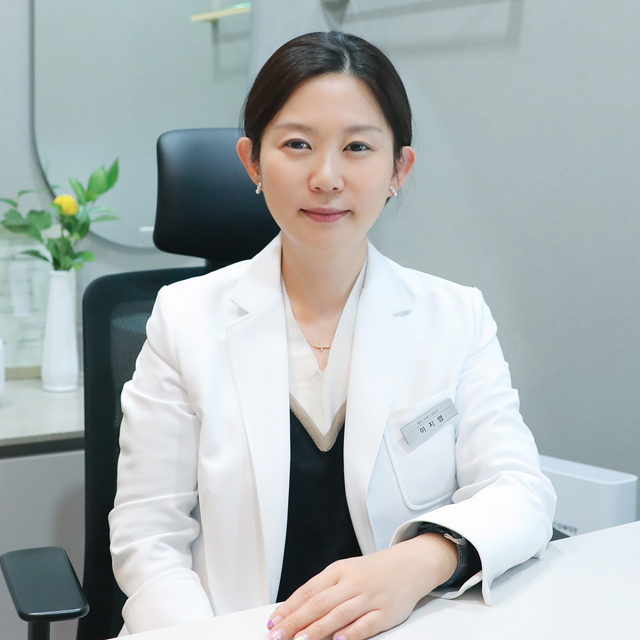
Dr. Lee Jiyoung
Board-certified Dermatologist
Assessment and treatment are carried out by Dr. Lee Jiyoung, Chief Director of SeoJeong Dermatology and a board-certified dermatologist in South Korea with more than 20 years of clinical experience. Her medical education and her dermatology specialist training were both completed in South Korea, and she holds an ECFMG certificate.
The consultation is a diagnostic one, not simply a planning conversation. The clinician reviews the sweating pattern, its duration, its severity, its impact on daily life, the medical history, medications and previous treatments. The affected area is assessed, and the question of whether an underlying condition or a medication could be causing the sweating is considered explicitly. A starch-iodine test may be used to map sweating in selected cases.
Before establishing the clinic in April 2022, she was Director at Cheongdam Lee Ji-ham Dermatology Clinic, at B&C Dermatology Clinic's Gangnam branch, and at CU Cleanup Dermatology Clinic's Yeongdeungpo branch. She is a regular member of the Korean Dermatological Association, the Korean Association of Dermatologists, the Korean Academy of Anti-Aging Dermatology, the Korean Acne Society, and the Korean Atopic Dermatitis Association. SeoJeong Dermatology is a single-physician clinic, and a dedicated global coordinator supports international patients with English-language communication.
Treatment is carried out under the direction of Dr. Lee Jiyoung; this page does not claim that one specific doctor personally performs every session of this service.
Who Is a Good Candidate for Hyperhidrosis Botox?
This treatment may suit:
People with excessive, localised sweating that interferes with daily activities.
People who have not obtained sufficient relief from topical antiperspirants.
A dermatologist should confirm the diagnosis and determine whether injections are appropriate — the diagnosis first, and the treatment decision second.
Treatment may be inappropriate for:
People with a known allergy to the product or its ingredients.
People with an infection at the injection site.
People with certain neuromuscular disorders.
People with other relevant medical risks.
Pregnancy and breastfeeding require individual medical advice, because safety and treatment suitability must be assessed rather than assumed.
The impact of the condition is a legitimate part of the assessment. DermNet describes axillary hyperhidrosis as leaving clothing damp and stained and needing to be changed several times a day, with wet skin folds prone to chafing, irritant dermatitis and infection; palmar hyperhidrosis as producing slippery hands, avoidance of handshaking, marks on paper and fabrics, difficulty writing neatly, and malfunction of electronic equipment such as keypads and trackpads; and plantar hyperhidrosis as causing unpleasant smell, ruined footwear, and susceptibility to secondary infection. Those are the daily costs a patient is weighing, and they are the reason this is treated as a medical complaint rather than a cosmetic preference.
What to Expect: Procedure, Recovery, and Results Timeline
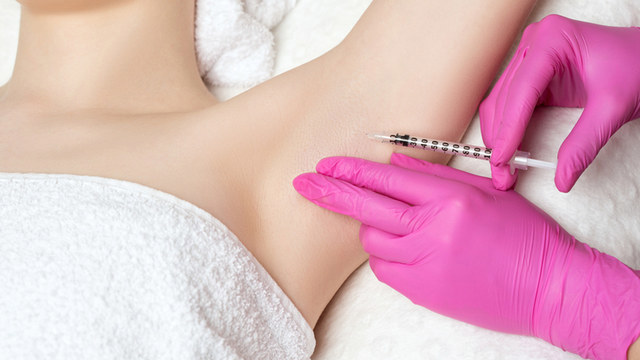
The session runs through five steps. The clinician identifies and marks the treatment area. The skin is cleaned. Numbing measures may be used, depending on the area and the patient's comfort. Small amounts of botulinum toxin are then injected into multiple points in the skin. Aftercare instructions are given and the patient leaves when appropriate.
The injections may cause brief pinching or stinging. Ice, topical numbing or other local pain-control methods may be considered, and the area being treated makes a real difference here — palms and soles are not the same proposition as underarms.
Stage | What happens |
|---|---|
Session length | Roughly 15 to 45 minutes, depending on areas treated |
Visit | Generally completed in one outpatient appointment |
Same day | Most patients resume ordinary daily activities immediately |
7 to 14 days | More complete effects are usually visible |
The total appointment time depends on the area treated, the assessment, the preparation and the pain-control requirements, so the booked slot is longer than the injection time itself.
Before treatment, tell the clinician about medical conditions, allergies, previous botulinum toxin treatments and all medications or supplements, and discuss blood thinners and medicines that can affect neuromuscular function. Do not stop prescribed medicines independently.
Afterwards, avoid rubbing or massaging the injection sites, and follow the clinician's advice on exercise, skin products and deodorant. Keep the area clean and monitor for unusual pain, increasing redness, swelling or other concerning symptoms. Seek urgent medical attention for difficulty swallowing, speaking or breathing.
Combining Hyperhidrosis Botox with Other Treatments
The documented alternatives are worth knowing even for a patient who proceeds with injections, because they are often used alongside rather than instead.
Clinical-strength antiperspirants are usually a less invasive initial option.
Iontophoresis uses a mild electrical current, particularly for hands and feet, and often requires repeated sessions.
Oral medicines may reduce sweating but can cause systemic side effects, including dry mouth and reduced ability to cool the body.
DermNet adds practical measures that cost nothing to try: wearing loose-fitting, stain-resistant, sweat-proof garments, changing clothing and footwear when damp, using absorbent insoles and replacing them frequently, using a non-soap cleanser, avoiding caffeinated food and drink, and discontinuing any drug that may be causing the sweating. It also notes that deodorants are fragrances or antiseptics to disguise unpleasant smells and do not on their own reduce perspiration, which is a distinction many patients have never been told.
Safety, Precision, and Clinic Standards
The documented risks are injection discomfort, redness, bruising, swelling, headache and itching. Treatment of the hands or feet can cause temporary muscle weakness that may affect grip or movement — a consideration for anyone whose work depends on fine hand control, and one to raise before the appointment rather than after.
The NHS states that all cosmetic procedures carry some risk, whether surgical or non-surgical, and that they can lead to serious complications if not done correctly. Its advice is to choose a reputable, safe and qualified practitioner trained and experienced in the procedure you are having, and to ask about the procedure, the products used, and what could go wrong.
At SeoJeong Dermatology, treatment planning is carried out by a Korean board-certified dermatologist, each patient receives an individual skin assessment to select treatments suited to their needs, and consultation precedes the selection of any procedure. The clinic is a Registered Medical Institution for Attracting Foreign Patients, certified by the Ministry of Health and Welfare in compliance with the Medical Overseas Expansion and Foreign Patients Attraction Act; its business registration number is 342-17-01916.
NHS guidance on having cosmetic treatment abroad advises finding out what happens if there are complications, where follow-up appointments will be, and how easily you could travel back to the destination where you were treated. It notes that overseas clinics may not provide follow-up treatment to the same standard, and advises asking whether the practitioner speaks a language you understand, since they need to be able to explain the procedure and understand your concerns.
The Bottom Line
The injections block the nerve signal to sweat glands in the treated area; the glands are not removed.
Underarms, palms, soles and selected facial areas are the usual sites.
Diagnosis comes first: asymmetrical, generalised or night-time sweating may point to an underlying cause.
More complete effects are usually visible within seven to fourteen days, and the effect is temporary.
Treating hands or feet can cause temporary weakness affecting grip or movement.
Frequently Asked Questions
Will this stop my sweating completely?
Not necessarily. The degree of improvement varies, complete dryness is not guaranteed, and the effect is temporary. What is realistic is reduced sweating in the treated area and less dampness.
How soon does it work?
More complete effects are usually visible within seven to fourteen days after treatment.
Does it hurt?
The injections may cause brief pinching or stinging. Ice, topical numbing or other local pain-control methods may be considered depending on the area.
Can my hands be treated?
Yes, palms are a common site. Treatment of the hands or feet can cause temporary muscle weakness that may affect grip or movement, so this is discussed before treatment.
What is the starch-iodine test for?
It maps where sweating is actually occurring, and may be used in selected cases to define the treatment area precisely rather than by estimate.
Should I try anything before injections?
Clinical-strength antiperspirants are usually a less invasive first option, and iontophoresis is an alternative particularly for hands and feet. Which order makes sense is part of the consultation.
When should I seek urgent medical attention?
For difficulty swallowing, speaking or breathing, and for unusual pain, increasing redness or swelling at the injection sites.
Can I have the consultation in English?
Yes. International patients receive consultations in English at SeoJeong Dermatology, supported by a dedicated global coordinator who handles English-language communication and consultation arrangements.
Book a Consultation at SeoJeong Dermatology
The first task is to establish what kind of sweating this is, because that determines whether injections are the right answer or whether something underneath needs attention first. SeoJeong Dermatology is at B-123, Lobby Floor, Acro Vista Arcade, 188 Seochojungang-ro, Seocho-gu, Seoul, South Korea. Opening hours are Monday and Thursday 09:30–19:30, Tuesday and Friday 09:30–18:30, and Saturday 09:30–15:00, with a lunch break from 12:30 to 13:30 Monday to Friday; the clinic is closed on Wednesday and Sunday. To arrange a consultation, use the contact page, call +82-2-533-9300, or email info@seojeongclinic.com.
Incheon International Airport is roughly 11 to 13 hours' non-stop flight from the US West Coast and 14 to 16 hours from the East Coast, with departure hubs including Los Angeles, San Francisco, Seattle, New York, Chicago, and Atlanta; Seocho-gu is reached from Incheon by airport limousine, taxi, or public transport. Arriving at least one day before the appointment allows time for travel recovery and the consultation. Korea Standard Time is UTC+9. US citizens are currently exempt from K-ETA only until 31 December 2026, which may change from 1 January 2027, and a digital e-Arrival Card has been mandatory for every entry since 1 January 2026.
Disclaimer
This page is for general information only and is not a substitute for individual medical advice, diagnosis, or treatment. Outcomes vary between individuals, and no specific result is guaranteed. Please consult a qualified medical professional about your own circumstances.
Sources & Further Reading
DermNet — Hyperhidrosis — eccrine gland distribution, primary versus secondary patterns and their causes, the daily impact at each site, the Minor starch-iodine test, and the documented role and duration of botulinum toxin injections
NHS — Before you have a cosmetic procedure — risks of surgical and non-surgical procedures, and choosing a practitioner
NHS — Cosmetic surgery abroad — complications, follow-up and language when treated outside your home country
Other Services
Explore additional treatments offered by our specialists.

Wart & Corn Cryotherapy
Wart and corn cryotherapy in Seoul is a treatment at SeoJeong Dermatology in Seocho-gu that uses an extremely cold substance, usually liquid nitrogen, to destroy wart tissue.
Learn More

Thermage Skin Tightening
Thermage skin tightening in Seoul is a non-surgical treatment that uses radiofrequency energy to heat deeper skin tissue and support collagen remodeling.
Learn More
Re2O Skin Booster
Re2O skin booster in Seoul is a skin booster based on human-derived acellular dermal matrix, used in aesthetic treatments intended to improve skin texture and firmness.
Learn More